Angels Disguised

Inadvertently over the years, I have stumbled into danger’s path. Living in Valencia, Spain, the last four months has not exempted me from a dance or two with death. Two weeks ago, I was walking in Old Town on a minuscule “sidewalk” when a man rounded the edge of a building with such velocity, that I instinctively stepped off the sidewalk and into the street to avoid impact. That reflexive move put me right in the path of a car. Instantaneously the man grabbed my arm and yanked me to safety just as the car sped passed. He hurried on his way while I attempted a breathless “Gracias” to his back. This incident was followed a few days later while crossing an intersection, and suddenly feeling solidly rooted to the ground and unable to move. A bicyclist, not heeding his red light, barreled past and missed me by centimeters. Both episodes would have done more damage than just a hard knock to the noggin.

I wonder aloud (more often than Steve cares to count) about the odds of simultaneous events– the man, me, and the car all converging at that exact spot on Carrer de Calatrava and Cadirers. What kind of energy and ensuing motion compels things to arrive at the same place, at the same time? Everything in the world is in motion all the time– even things that look perfectly still are packed with atoms that are vibrating with energy. While I cannot see that energy that brings random things together, any more than I can see time or gravity (mysterious forces I’d love to see), I am content most days to marvel at coinciding events. There’s no doubt in my mind though that a great and powerful Oz behind the curtain is running the show.

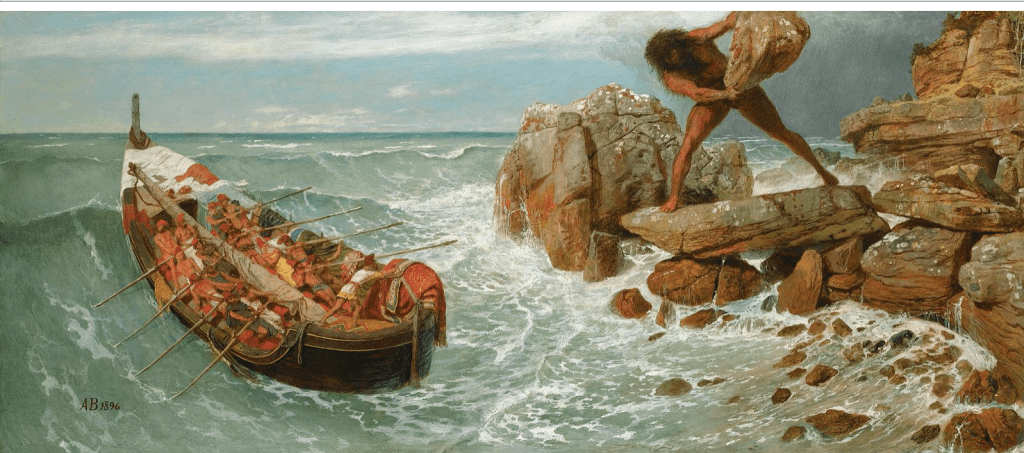
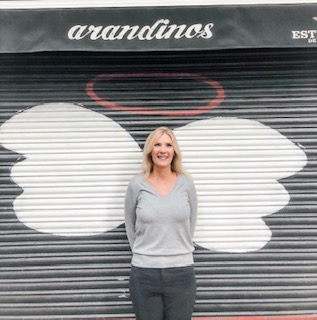
I’ve been under the assumption since my dad passed away over a decade ago, that he has been the angel watching my back wherever I wander. As a man who was struck by a drunk driver, and later hit by a loose boom arm of a passing cement truck, he understood danger can be dogged in its pursuit. And like the one eye Cyclops Polyphemos in Greek Mythology, who tried to kill Ulysses and ruthlessly pursued Galaeta the sea nymph, Death–that single eyed monster– occasionally gets us in his site. I don’t believe danger is around every corner and wispy winged guardian angels constantly flutter above, but neither do I believe in tempting fate and stepping in front of a car on purpose. I do believe though that there are angels in human form, as well as unseen guardian angels that step in when danger pursues and tries to court us.
George Sand wrote it better than I could: “I believe that there are angels disguised as men, who pass themselves off as such, and who inhabit the earth for a while to console and lift up with them, toward heaven, the poor, exhausted and saddened souls who were ready to perish here below.” 

On an Italian Journeys tour with Nancy DeConcilis in Rome several years ago, we visited Villa Farnesina where Raphael had painted a fresco for Agostino Chigi called the Triumph of Galatea. In the fresco, Tritons from the depths below are set on abducting Galatea and her nymphs, but cherubs armed with bows come to Galatea’s rescue to fight off the sea creatures. This painting has stayed with me over the years as I am just sensitive enough to recognize that I too have had angels come to my rescue when I need it.

Spaniards, whether by Catholic culture or not, believe in angels, as evident by walking through their Belle Arts Museum and glancing around at the master’s works. I took these three photos within five minutes of entering the museum. Spinning a circle, I noted there were angels in numerous paintings. I sat on a bench in front of the middle painting, El Arcangel San Gabriel by José Camarón Bonanat. Gabriel was the angel who appeared to Mary and told her “fear not.” I recalled the myriad of ways my family and I had been protected by unseen hands over the years and felt my pulse quicken. Gradually my fear of all those close calls was replaced by immense gratitude. I left feeling lighter and buoyed with hope for the future.

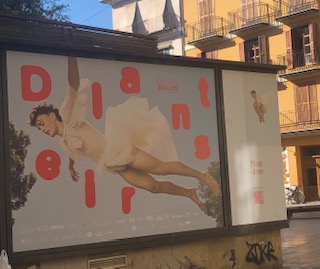
This morning, trying to bypass a film crew on my street for some upcoming movie, I wandered a new way to the grocery store, and my eyes fixed on a billboard for a dance troupe’s new production with a man with angel wings. I had to stop and look at it for a moment, as I find these types of synchronicities fascinating. Once I am mindful of something, these subtle messages crop up routinely for me to see if I pay attention.

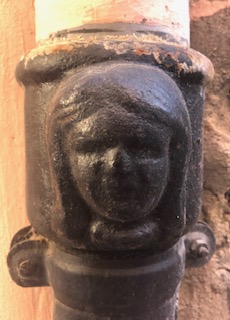
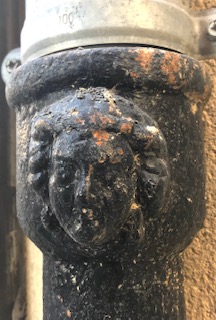
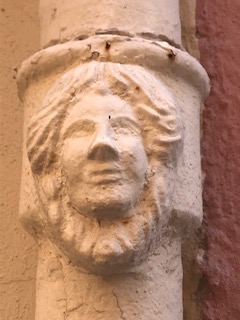
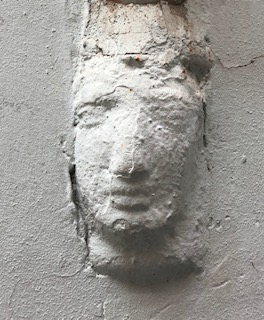
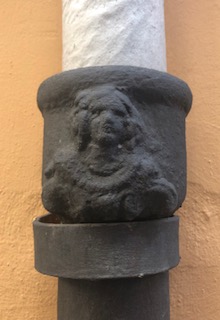
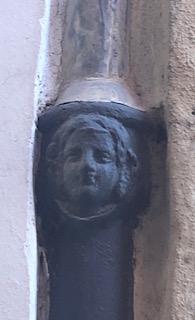
Steve, while walking to Spanish classes a few months back, started noticing little angel faces on building’s rain gutter pipes. He used to see cherub forms or “putti” on building’s bas relief, and in paintings while living in Sicily years ago, and he mentioned these faces to me one day in passing. I had not paid attention, but on my way home from grocery shopping, and having to zig zag and bypass more streets blocked for filming, I saw for the first time, five of these little guardian angel faces on the drain pipes. I smiled at these angel representatives, tucked away, unobserved, who kept watch.
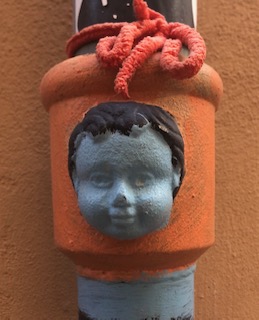
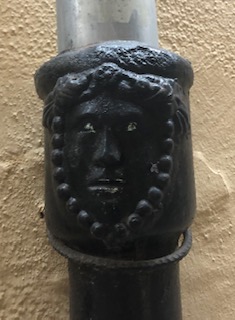
After a bit of searching online for info about these, I found in the late 1800s, when city planners modernized the drainage, they involved civil engineers and metallurgic companies. Two of them, Fundicion Ferrer Valencia, and Don Tomás Aznar y Hermanos, had added these angel faces to the pipes. Romans, the founders of Valencia, used to add figureheads on the bow of their ships and galleys to keep them safe. As a nod to ancient Romans, the engineers may have made these angel faces as guardian angels to the city of Valencia. I found it charming to think these angel faces had been there over 150 years just watching over Valencians.

These faces got me thinking about the Patriarca Museum I visited last month to see two Caravaggio paintings, I noticed right before I left, there was a display case with “the Guardian Angel of the City of Valencia” made in the 1700s. It was a reproduction of King Jaime, who freed the city of occupation, and became the city’s guardian angel. On my way home it was not lost on me that for the first time I finally understood the meaning of the name of the street that led to my apartment. It was called Calle del Angel Custodio— Guardian Angel street. Critics would say its apophenia or abnormal meaningfulness or just a coincidence, but to me it was another nod of synchronicity and knowing we are never left alone nor unprotected.

“Not all angels are from the other side of the veil. Some of them we walk with and talk with—here, now, every day. Some of them reside in our own neighborhoods..” Jeffrey R Holland
This afternoon as I sit with earplugs in and music on, trying to drown out the new construction drilling and hammering on the building that connects to ours, my eyes landed on the Halloween card from my angel friend Janet who is always inspired to send love and encouragement a week or two before it is needed. Her card reminds me that with all the scary things out there, and one eyed monsters bent on our destruction, and myriad of ways to perish, I do not need to be worried. Fear not. We are all watched over more than we know.

Possibility of Something New

The first verb I learned to conjugate in every one of our foreign moves was “posso,” (Italian and Portuguese) and “puedo,” (in Spanish). This Latin root means “to be possible or able.” I use posso/ puedo frequently to ask the question “Can I?” (Can I see the total amount? Can I write down my email for you instead of telling you the letters?) Latin base words that pepper the English language are like dear friends from home who bring the welcoming feeling of the familiar when they pop in for a visit. A cognate such as possible is not only a useful verb and familiar friend, it is also the framework for each of our moves– the possibility of building new friendships, exploring new sites, and emotional and mental enrichment. As we settle into our third month living in Spain, with all the possibilities and choices before us, I ask myself: can I let go of the ruins of the past, build on them and embrace something new? Can I create a world where work resembles play, where time is not scarce, where growth is a byproduct of a changed mindset?

The creation of something new is not accomplished but the intellect, but by the play instinct acting from inner necessity. The creative mind plays with the objects it loves. Carl Jung

Growing up on a family farm where it was all work, and play never entered our orbit, I was shocked to learn in science class that work and play complimented and wrapped around each other like a spiral staircase, similar to the double helix in our DNA structure. These DNA double helixes, had major grooves and minor grooves. As a beast of burden, I decided my major groove must genetically be work, (wider with more proteins binding to it); and my minor grove was play, (narrower and less binding). Even after learning our minds and bodies need rest and play after exertion, the possibility of play always seemed out of reach, until one day a year ago when I was confined to bed post surgery, flat out in the midst of personal crisis, as I could no longer work. I began to hold onto the possibility that “It was never too late to have a happy childhood,” and moving to Spain became the impetus to finally getting around to the science of playing.

It didn’t take long after putting down stakes in Spain to see that Spaniards excelled at relaxing after work, and thoroughly enjoyed playing. Every afternoon they could be found playing on soccer fields and lounging in outdoor cafes in animated conversation, and laughing during their evening strolls called ‘paseo.‘ We noticed festivals and fireworks sprung up every few weeks and everyone, even children, took to the streets until the wee morning hours just enjoying life. Over the weekend, Spaniards, from all around the country, flocked to Valencia to join in the liberation festival commemorating Conquistador King James I of Aragon who took back Valencia from the occupying Moors in 1238. As we walked around seeing Spanish women and men beautifully arrayed in their traditional costumes, dancing and singing, I felt a deep longing bubble up, the need to play, and I wanted to join in the fun.

In this place, working on a second chance of having a happy childhood, I admired how Spaniards put up ceramic plaques commemorating those who worked hard at play– bullfighters, or matador’s who danced in front of angry bulls, and neighborhoods lauded on plaques for playfully building the best paper mache monument that was burnt during a three week Falle festival marking the coming of Spring. The Falles filled with parades, music and dances and traditional costumes and fireworks commemorate the endless possibilities of a universe of play.

“They stand in the great space of possibility in a posture of openness with an unfettered imagination for what can be.”

It is hard to move from spectator to participant, even when there is a will. In the Art of Possibility, psychotherapist Rosamund Zander writes that one of our roles in life is to radiate possibility into the world, and we do this by changing our mindset, and turning everything into play. By seeing life as a game and seeing ourselves as a game board, “we shift the context from one of survival to one of opportunity for growth.” This change of mindset opens up new opportunities of shifting the paradigm of the necessity of work to include the necessity of play.

In order to “Dwell in Possibility” as Dickinson wrote, and make everything a game, our first field trip play day was taking the train to the Roman ruins of Sagunto just North of Valencia. Living without a car in Valencia has been fantastic and challenging at once, and for the first time in our married life, our only option was bus or train. We chose the train. On an early Saturday we settled into public transportation seating and gave full relaxed attention to the scenery going by, and laughed and talked and not surprising it seemed like play.

The thirty minute train ride to go twenty miles up the coast to Sagunto, sped by quickly. Citrus and olive groves watched us glide past. An occasional villa appeared on the expansive farm land extending to the ocean. Getting off the train, the wind picked up but we fixed the chills by walking on the sunny side of the street below Sagunto castle.

The charming old town we passed through, to get up to the ruins, with its bulging ancient walls, wacky staircases, tiled thresholds on restored rustic buildings and little nooks and crannies filled with colorful potted plants was delightful. The walk up the hill, while steep, was better than catching the miniature green train chugging uphill, as we were able to poke around and read the orange historical signs. We found ourselves in a dead end a time or two, but upon turning around and retracing our steps, we were captivated by the lovely views we had had at our backs all along. Meandering and dawdling in a new place always encourages it to open up its secrets.

Arriving at the ruins, an old admiration for the Romans kicked in. These masters at concrete always left behind structures that lasted for thousands of years. And when building a new city, the Romans always made space for an amphitheater for drama and gladiators, and a circus for chariot races along with the forum, basilicas, and temples. They understood the need for play after hard work. Over the years, we have visited ruins in Rome, Italy; Nimes, France, and Italica, Spain, and Sagunto did not disappoint. The Almenara fortress Gate, perimeter walls and foundations of the Forum still stand. The mix of Iberian defensive walls, the Roman retaining walls reinforced by buttresses, Islamic medieval arches mixed in with Christian Gothic and Renaissance rework of towers and bastion was an impressive, creative, collaborative work. Cisterns, millstones, granaries, ovens for bread, shops and homes on the immense hilltop fortress overlooking lush fields below with thousand year old olive trees still producing olives for oil, and grape vines that filled the ancient amphorae displayed around us with wine, made the past feel present with possibility. Soren Kierkegaard undoubtable felt this as he penned, “What wine is so sparkling, what so fragrant, what so intoxicating as possibility.

The Roman philosopher Seneca said: “Let us live, since we must die.” The thought of living life after cancer and a brush with mortality swirled around us on this hilltop fortress, and we contemplated again leaving behind us a memorial of our lives, a monument of continued work, eat, sleep, repeat….or moving onto a narrower rockier path which required stretching, playing, living small but purposefully, with new ways to exist, and leaving behind a legacy of truly living. Horace, a Roman poet, said: “Nil Desperandum” or “We don’t despair, but live.” While worry and work had its place in our lives, we chose again the livelihood of living, and the possibilities of something new with play.

We, the insistent on living, looked past the ruins, enjoyed the sun on our shoulders, the breeze coming off the ocean and breathed in life. There was nothing checked off the to-do list but so much was accomplished. We stepped unimpeded, with openness, imagination and playfulness into the great space, the universe of possibility where living happens. We all can. See you there.

Playfulness allows us to see things from different angles and may sometimes save us.”
― Erik Pevernagie

Website Built with WordPress.com.

Up ↑