


“Most [people] either compromise or drop their greatest talents and start running after, what they perceive to be, a more reasonable success, and somewhere in between they end up with a discontented settlement. Safety is indeed stability, but it is not progression.” ― Criss Jami
Nothing like a heat wave in Valencia and not being able to use a/c, thanks to Russia’s war with Ukraine, causing Spain’s record high, unstable, electricity costs, to make us scramble to find a place with cooler weather. The 60 degree temps in Scotland in June made it an easy decision to hop on over.
I brought along a book of Ernest Hemingway’s short stories as the UK was reporting long lines at the airports. I contemplated and dismissed bringing my laptop to catch up on long overdue blog posts, as the last several months lingering COVID brain fog has left me discombobulated and feeling like my musings are trivial and pedantic. During the long wait at the airport, I read Hemingway’s The Snows of Kilimanjaro, written in 1936 while he worked in Spain as a journalist and reporter during their Civil War. In the story, the protagonist Harry has been injured on his trip to Africa and is dying from gangrene. He laments: “Now he would never write the things that he had saved to write until he knew enough to write them well. Well, he would not have to fail at trying to write them either. Maybe you could never write them and that was why you put them off and delayed the starting. He would never know now… he would never do it, because each day of not writing dulled his ability and softened his will to work so that, finally, he did not work at all.“
This prodded my brain: “each day of not writing, dulled [my] ability,” and the thought hovered as we touched down and drove through Edinburgh. Certainly there is safety and stability staying on the non-writing sidelines, but if the cost was a “discontent settlement,” and ‘non progression,’ then returning to my scribblings, despite a cotton filled, dizzy head was imperative. I was reminded of one of the lessons from childhood, from my physical therapist mom, that dizziness and instability was never an excuse for inactivity. She would get patients up and walking right after surgery, even while the room was spinning and weakness threatened their collapse. And as part of her patient’s dizziness recovery, she would have them turn circles, with arms reached straight out from their sides, to help their brains learn stability in their instability. It seemed counterintuitive that to become stable, you first had to make and embrace the unstable. This memory felt like a nudge, to keep writing when I felt like I couldn’t write anymore… and in the continued writing, I would find the stability in the (in)stability.
Nothing is stable including life itself.” – Sunday Adelaja
Edinburgh was rainy and chilly our first full day, and the walk through the Princes Street Gardens, under the imposing Edinburgh Castle, was just what we needed. We stopped at the Scottish National Gallery to see the works of some of the masters: Degas, Van Gogh, Sargent, Correggio, Raphael, Da Vinci, Velasquez, Botticelli and Monet.

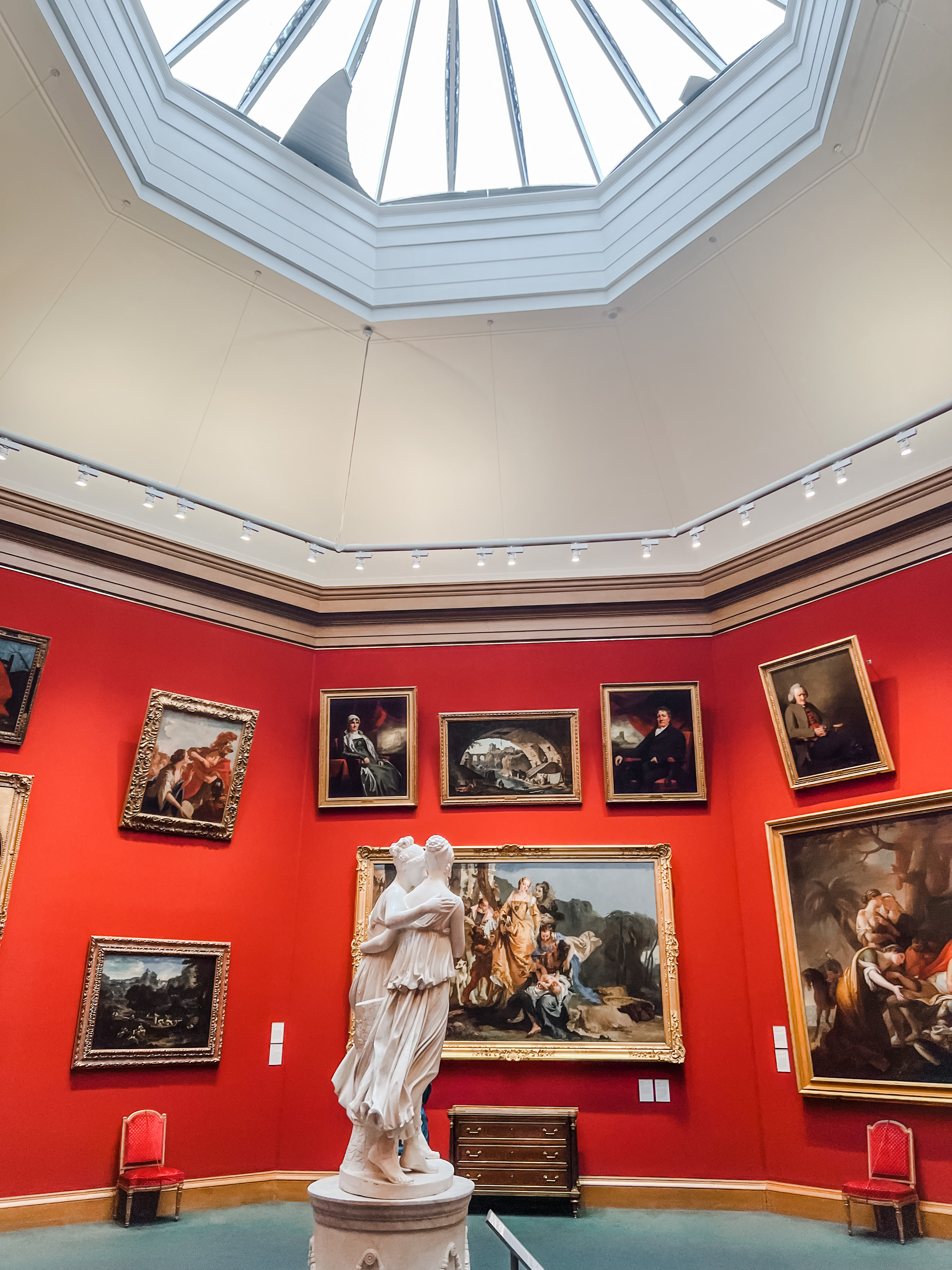

One of my favorite paintings in the museum was not Claude Monet’s “Haystacks,” that everyone rushed to and crowded around, but his little known Seascape. Monet’s father wanted him to pursue a career in business, and Monet tried to appease him and find joy in it, as that was where the money was, but Monet’s passion was for art. He left home for Paris and studied with the masters, but struggled with depression, self-doubt, poverty and illness, and considered giving up. He met and married Camille and together they experienced even greater financial hardship. Monet was so despondent, that he attempted to drown himself in the River Seine. His wife died with TB after the birth of their second child, and Monet was at a crossroads. Give up and return to stable businesses a career, or carry on in the instability of painting and pursue his passion. He wrote, “It’s on the strength of observation and reflection that one finds a way. So we must dig and delve unceasingly.”

“No one knows the anxiety I go through, and the trouble I give myself.” C. Monet
Monet dug deep and created, and failed, delved into other styles, didn’t care for them, reflected upon what he enjoyed, which was painting flowers. Eventually, he came up with a technique called “en plein air,” as he painted a Still Life, a static jug resting on the table. It depressed him so much that he took the jug painting outside, and painted over it with this stormy sea at Honfelur Harbor in Normandy. The bold techniques and thick dark paint were very unusual for Monet, but this was the beginning of his love of outdoor painting, “en plain air.” Traditionally artists painted inside in a workshop, where they ground minerals for pigment, mixed paints and sat their subjects, but Monet despite the chaos and disorder of throwing everything into his satchel, he bound his supplies and his easel to himself and headed into nature to paint. He painted what he saw in the world around him…the fields surrounded by wildflowers, ponds with waterlilies, and did what made his heart leap. His enlightened work became sought after, and he painted contentedly for the rest of his life achieving financial solvency.
Disorder is inherent in stability.” Tom Robbins


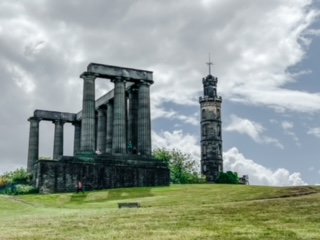
Edinburgh’s Folly on Calton Hill
We followed up the art museum, built by city architect William Playfair, by taking Mary King’s Close tour under Edinburgh, and the following day by climbing Calton Hill for the birds eye view over Edinburgh. At the top of the hill was a section of columns copied from the Parthenon in Greece. Edinburgh city officials tasked William Playfair to build a replica of the Acropolis as a way to commemorate the Scots who had lost their lives in the Napoleonic Wars. Because Lord Elgin had just brought the British museum some Entablatures from the Parthenon, known as the “Elgin Marbles,” Playfair was inspired to continue the Greek theme. However, in 1829, the money ran out, and the Parthenon on Calton Hill was never completed. The roofless shell became known as “Edinburgh’s folly” or disgrace. A folly is an architectural element, but it plays on the meaning of a folly being a lack foresight, and an unstable undertaking. William Playfair, worked hard to push past the reputation of his unfinished facade of the Edinburgh Parthenon and went on to complete the University of Edinburgh, the Observatory and the Royal Institution. It was a life lesson and reminder that we are not the sum total of our mistakes, missteps, unfinished undertakings if we move past letting them define us and allow them to redesign us. Architect Playfair didn’t tuck tail, find another career, stay in the stability of laying low, but he kept on building in Northern Ireland, England as well as Scotland and he progressed while pursuing what made him tick. And Edinburgh is a remarkable city because of his talents.
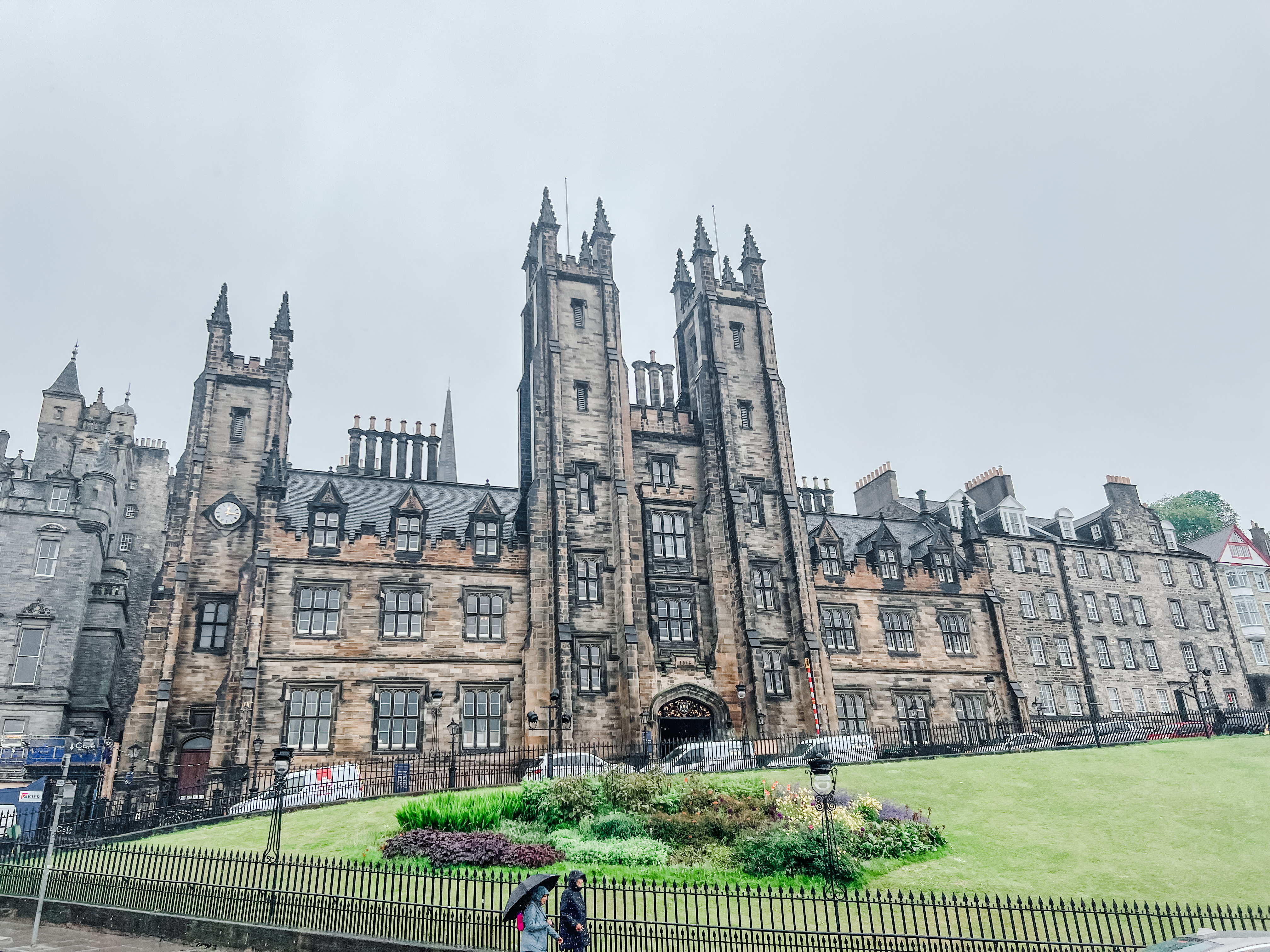
William Playfair’s University of Edinburgh
This reminded me of a biography I read on Madame Curie. She said something that applied scientifically as well as to life in general: “Stability can only be obtained by inactive matter.” It is less drag and energy to be inactive matter… But while it is stable, the unproductive mass only takes up space. In that vein, if happiness is to be found in creative outlets and pursuits, writing, painting, building, etc., a period of floundering, instability and evolving, is worth the energy and output to become active matter. This is where joy and steady footing in life is found. As Saul Bellow aptly put it: ” My balance comes from instability.” The drumbeat of the trip seemed to be surrendering to instability.
With the rain as our companion, the next day we took a train to Stirling to see one of the most important castles in Scotland. Stirling Castle was built in a strong defensive position, high on a stable sill, where molten lava rose from far below, but the history inside the castle had its share of instability.


“I choose unstable possibilities. I choose to surrender myself to that instability.” -Haruki Murakami
James IV started building Stirling castle during his reign, and his son James V took over completing the castle after he married French Marie de Guise. Their daughter, Mary Queen of Scots, had an inordinate amount of instability after her father James V passed away. Her life was always in danger, and she stayed in France for a time before returning to Stirling with her infant son James VI. Mary was forced to abdicate her throne in 1567 by anti-Catholic forces, became a political pawn and was imprisoned for 19 years in various castles in England by her cousin Elizabeth I. Mary Queen of Scots was deemed guilty of treason by a fearful and jealous Elizabeth I, and was Mary was beheaded in 1587. It was a terrible business with a dull ax. But out of such an unfair and brutal time, Mary Queen of Scot’s legacy is that England and Scotland were united under a single ruling monarch, as her son, James VI, moved to England after Elizabeth I’s death and ruled both Scotland and England. He became Scotland’s most successful king. It was a time of stability and metamorphosis for the two countries. Out of instability, a transformation of stability became possible.
Homeostasis, from the Greek “state of stability,” is a core tenet of physiology. It is where the body intercepts distress signals, and corrects disturbances found in the organs, muscle and glands. The internal workings of the body constantly fight to maintain a stable state of equilibrium. For example, when we get chilled the body shivers; when we get overheated, the body sweats; when sodium spikes, the kidneys conserve water and expel salt. It monitors everything from temperature to blood sugar, but also calcium, oxygen, hormones, etc.. I am learning, as I fight for internal equilibrium and health, that to be truly happy in life, it requires breaking through homeostasis in our thoughts and behaviors, to reach our true potential. Our brain rests on autopilot, thinking and doing less, to try and save and conserve energy, and to overcome this default state wiring requires activating and challenging the brain. In the long run, breaking out of homeostasis, becoming unstable and uncomfortable for a time, brings more wisdom and happiness.
For instance, when starting a new exercise program, the pain and discomfort activates the brain which tells the body to quit and save energy. The brain will cajole and rationalize that there is too much exertion; but, when pushed through, the discomfort makes the heart and lungs stronger. With this understanding, comes the knowledge that when pursuing passions and talents, the brain will try to sabotage in order to conserve energy, but breaking though this, working harder and concentrating helps strengthen not only the brain, but the creativity within and without. It took Marie Curie over three years to isolate one-tenth of a gram of radium chloride. It was painstaking concentration and work. We have X-rays and cancer treatments because she fought past the homeostasis, sacrificed and followed her vision. Einstein’s theory of relativity was a struggle of eight years. The fascinating thing is when the brain tries to conserve energy, many times the outcome is boredom and deficiency. It is living an impoverished life internally. Pushing past this deficit requires purposefully trying new things, extending ourselves, working on our talents, goals, passions, and putting homeostasis and stability in the backseat to instability and new ground. The brain will resist, but continuing anyway, means the neurotransmitters fire, a sense of accomplishment and happiness reigns, when we produce something of value. We leave the cocoon of safety and metamorphosis into a better version of ourselves.
“Even the sun has its cycles of instability. Every revolution produces a new order. Every death is simultaneously a metamorphosis.” Jordan B. Peterson
“[The moon] … is an example of practiced instability … it wanes when it must, and reliably returns to full strength … it is a humble model of reasonable potential that I can emulate, and follow.”
― Terry Crawford Palardy
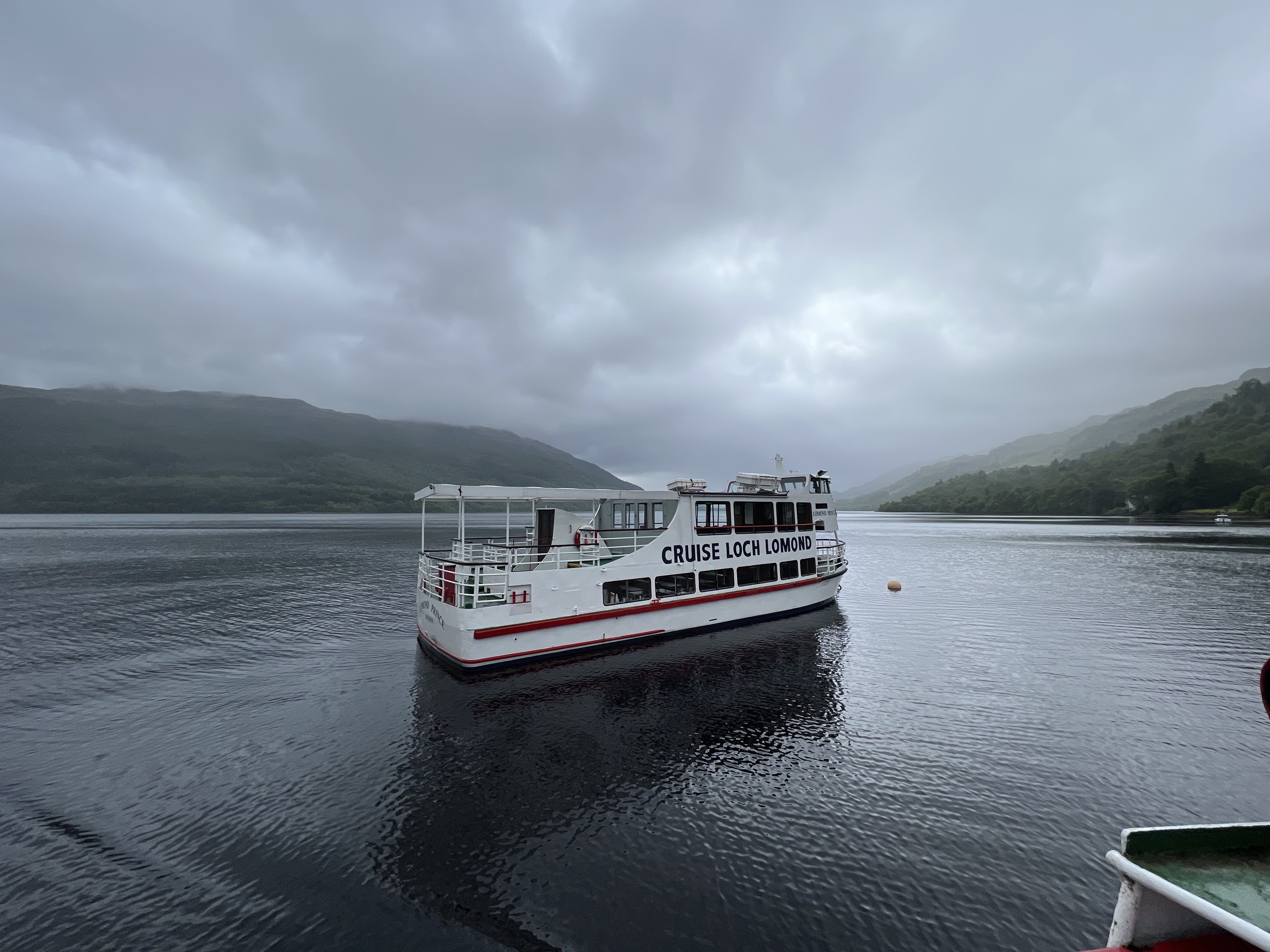
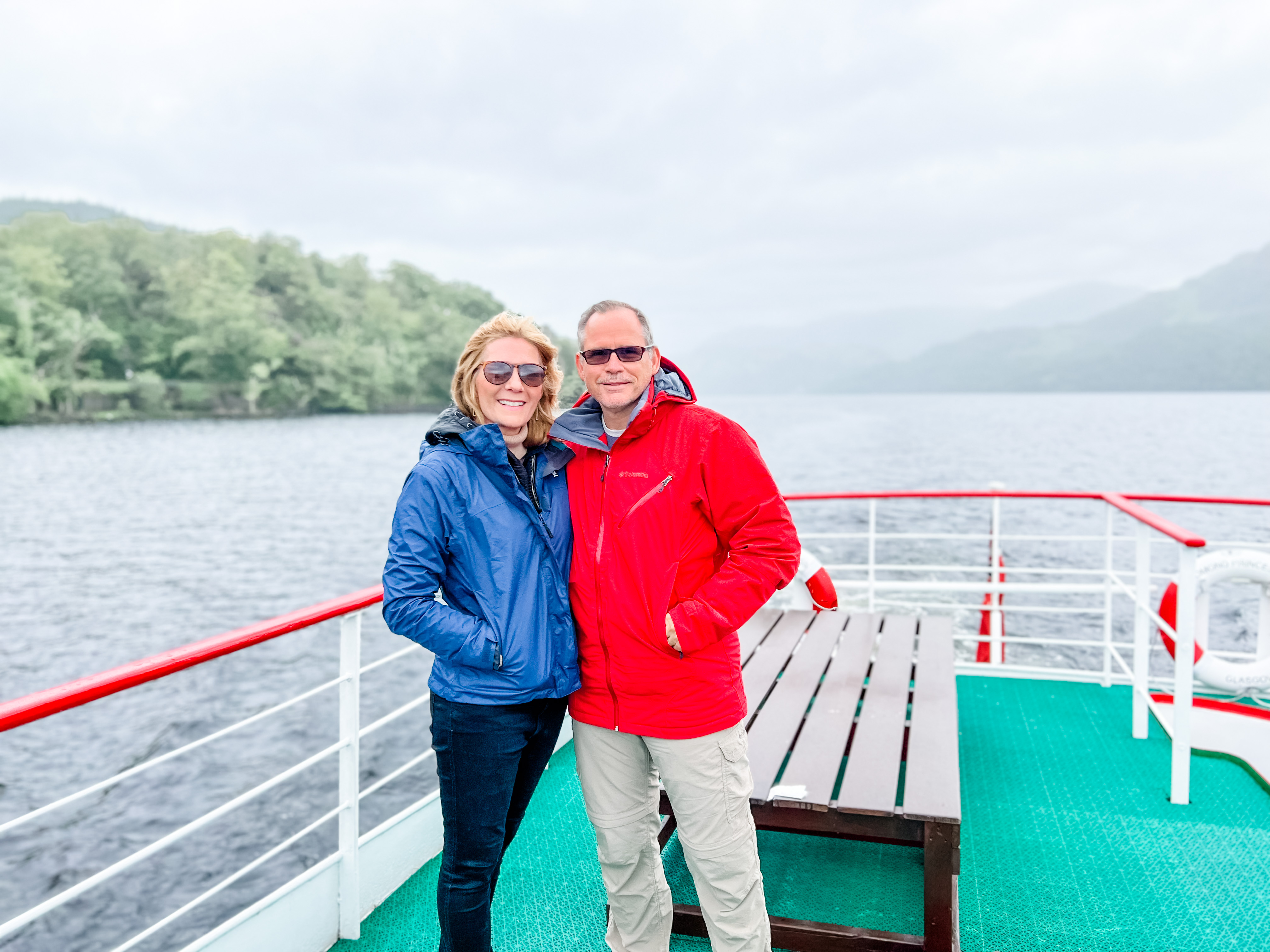
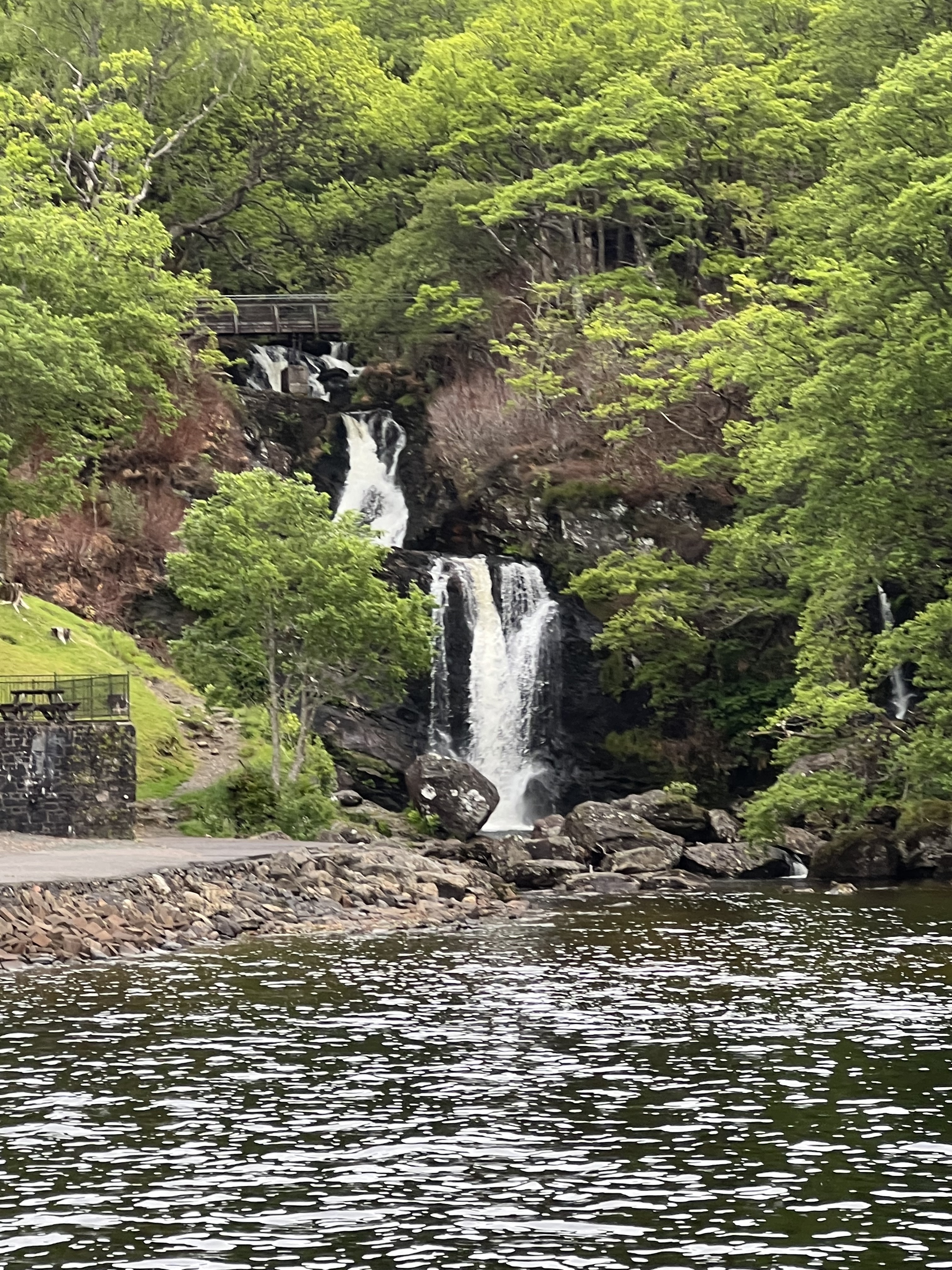
On our fourth day in Scotland, we took the train to Glasgow, and then hopped aboard the Highland Express, with stunning water views, to Loch Lomond. We were planning on hiking Ben Lomond mountain, but the unexpected heavy rain and shortened ferry schedules put a damper on all our plans. I felt disappoint and kept trying to make it work. Finally, I changed tactics and found a boat cruise on Loch Lomond on the northern fjords. The lake water started out like glass, but the wind and rain kicked up and suddenly the boat was rocking and passengers were getting whipped by the wind, and they ran for cover inside the boat on a lower deck. Steve and I had the upper deck completely to ourselves. It was unsteady with the waves and wind, but we widened our stance and engaged our core for stability and held on. We were rewarded with cascading waterfalls, and vibrant green hills, and I, the girl who likes a plan and tries to stick to the plan, was suddenly happy that our plans were all disrupted and that we carried on even when our brains said ‘give it up and stay in the dry hotel.’ “Practiced stability” and transformation. I like the idea of transforming into someone who pushes past the brain’s call to conserve and live impoverished… to become a person capable of accepting disappointment, who reroutes at dead ends, who glimpses the remarkable and works harder to achieve and create.
“A truly stable system expects the unexpected, is prepared to be disrupted, waits to be transformed.” -Tom Robbins

“There is nothing so stable as change.” Bob Dylan
In a time of upheaval with wars, fires, heat waves, lakes turned to dry beds, animal diseases leaping to humans, mutating viruses, etc., it is easy to give in to fear, depression and despondency. But in realizing unsteady footing helps us move differently, think differently, become more fluid and discover the time and life we have in front of us, however imperfect or disrupted, is a gift. Stability and safety make the brain less hyper-vigilant, but there are times when we must tell our brain– “That’s enough. Calmly step aside as I am challenging myself.”
I am a person who seeks peace and always tries to soothe, smooth and not rock the boat, but I have noticed by not rocking boat emotionally, and by avoiding a rocking boat physically, as I get seasick, I am limiting myself and squelching growth. As we are headed out to pursue sailing in the Mediterranean, I know it’s time to tell my brain and stomach to embrace the queasiness, the unsteadiness, and focus on the challenge, new skills and new horizons instead. Living in the dulled and softened places, that Hemingway’s character describes, is not where I want to reside. Leaning into the instability of possibilities, putting myself in the path that forces movement, allowing for waxing and waning of courage and lack of it, searching for the balanced in an unbalanced world, is an uncharted island for me but, .I know its the place transformation and metamorphosis inhabit.


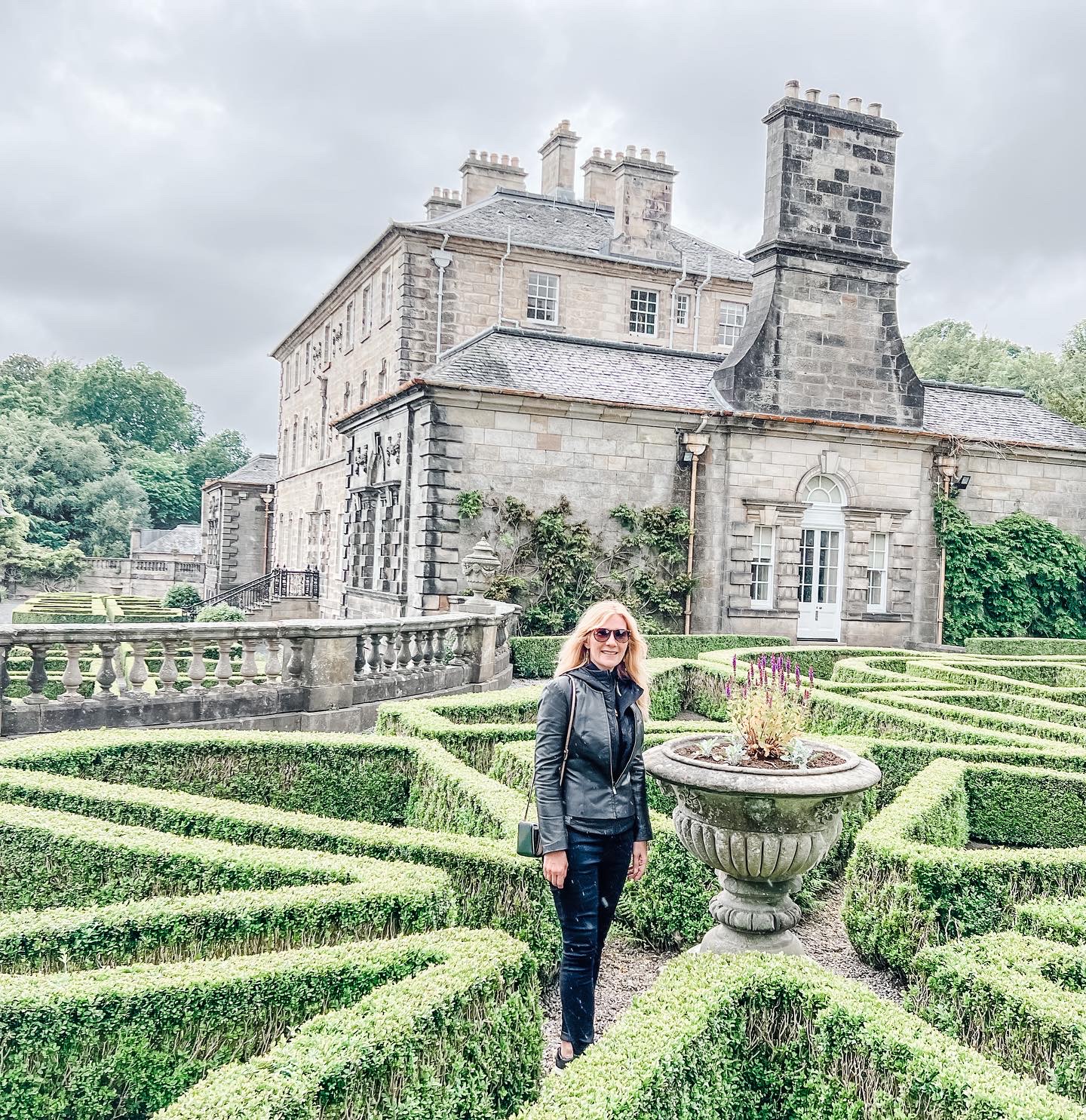
Pollock Park- Glasgow
As a visual learner, images and places help me find my way. This gem of a park in Glasgow, with its shaggy Highland cows, meandering river and shrubbery maze, has become my (in)stability muse. The Pollock family did not have the heirs to maintain it and gave it to the Glaswegians with love, and with the hope that it would inspire them to contemplate and create. It was here Steve and I further brainstormed a mystery thriller we want to write. The idea of sitting still long enough to write a book, and putting in the energy to finish it, makes me tremble and feel cattywampus. As the city fights the weeds and rodents rom taking over this Pollock home, I fight against homeostasis and giving up before I even start writing the book. The new path is worth the energy to find out where it leads, so I don’t each the end of my life and lament: “Now [s]he would never write the things that [s]he had saved to write until [s]he knew enough to write them well”. Join me in picking out your new paths, picking up old passions and pursuits, and understanding we are more than our body and brain impulses that convince us not to reach for what is just out of reach.
.




 The Unhurried Traveler